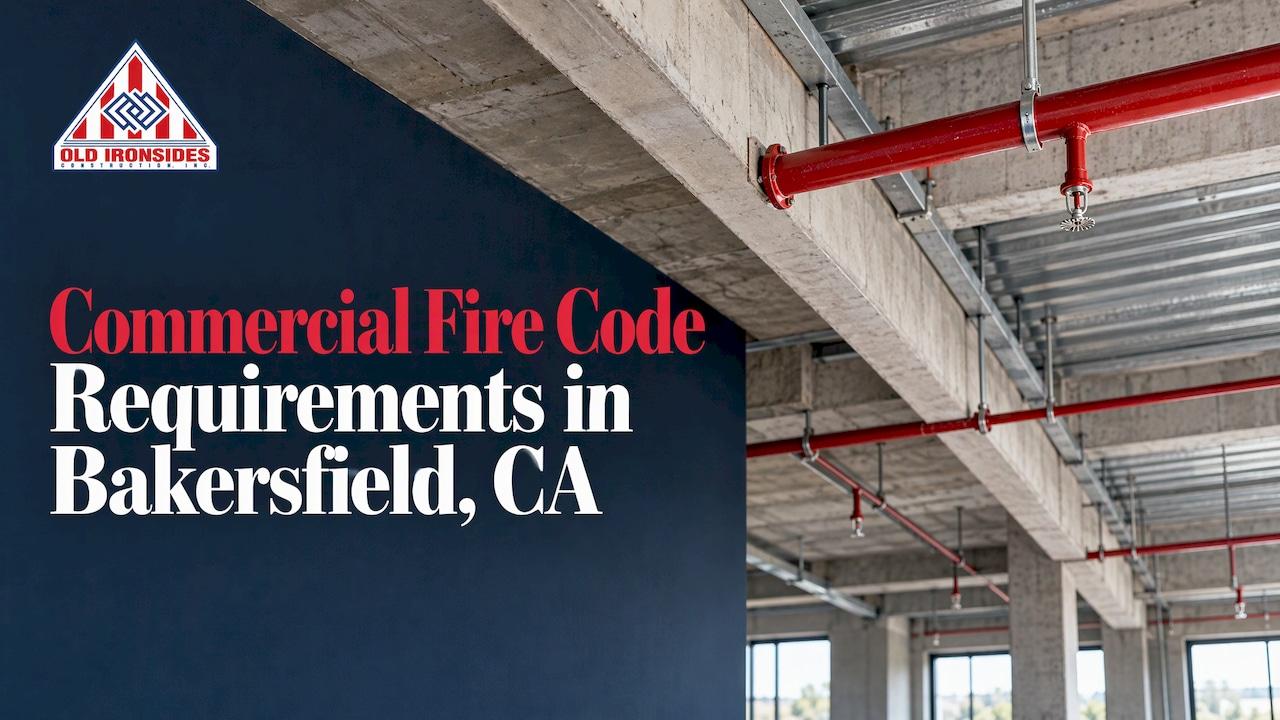
A commercial building in Bakersfield answers to the California Fire Code (Title 24, Part 9), as adopted and amended by the City of Bakersfield, and enforced by the local fire and building officials. What that means for your property depends on its occupancy group, size, and what you plan to change. This guide explains which codes apply, which requirements come up most often, the Bakersfield thresholds that surprise owners, and how to confirm the rules for your own project before design starts.
Table of Contents
- Which fire codes apply to a commercial building in Bakersfield
- How occupancy classification drives your requirements
- Fire protection features commercial buildings may need
- Inspection, testing, and maintenance duties
- When a renovation or tenant improvement triggers fire-code upgrades
- How to confirm what applies to your building
- Perspective: fire code belongs in the first conversation
- Plan your project with Old Ironsides
- FAQ
- Sources
Which fire codes apply to a commercial building in Bakersfield
There is no single national fire code that applies to every commercial building. Model codes are written nationally, then adopted by states and cities, which add their own changes. In California the result is Title 24 of the California Code of Regulations. The California Building Standards Commission says Title 24 applies to all building occupancies statewide and covers fire and life safety along with structural, mechanical, electrical, plumbing, energy, and accessibility rules.
Two parts matter most for you:
- Part 2, the California Building Code, based on the 2024 International Building Code.
- Part 9, the California Fire Code, which governs fire protection systems, operations, and existing buildings.
The Office of the State Fire Marshal develops the fire and life safety standards that go into Title 24. That includes standards for fire alarms, hazardous materials, assembly, educational, institutional, and high-rise buildings.
What Bakersfield adds locally
The state code is the floor, not the ceiling. Bakersfield adopted the California Fire Code through Municipal Code Chapter 15.65, which adopted the 2022 edition and lists local amendments. The amendments touch operational authority, operational permits, automatic fire-extinguishing systems, fire alarms, enforcement, fire apparatus access, and hazardous materials.
The 2025 California Fire Code took effect statewide on January 1, 2026. Cities adopt new editions on their own schedule, so ask the city which edition and which local amendments govern your permit. Outside city limits, the unincorporated county is handled by Kern County Fire Department, whose fire alarm guidance points to California Fire Code Chapter 9, Section 907, and NFPA 72.
How occupancy classification drives your requirements
Before anyone looks at sprinklers or alarms, the code asks what the building is used for. NFPA calls occupancy classification a critical step in applying building and fire codes, because it drives requirements for many fire and life safety features. The reasoning is about people: how alert they are, how familiar with the building, and how well they can look after themselves in an emergency.
The IBC-based system sorts uses into groups such as Assembly, Business, Mercantile, Factory/Industrial, and High Hazard. The group you fall into affects allowable building size, construction protection, egress, interior finishes, and fire protection systems.
| Typical use | Group family | What it tends to set off |
|---|---|---|
| Offices, professional services | Business (B) | Sprinkler trigger by building area in Bakersfield, alarm rules by size and occupant load |
| Restaurants, event rooms, churches | Assembly (A) | Lower occupant-load thresholds for sprinklers and alarms, wider egress demands |
| Retail stores | Mercantile (M) | Egress width, exit signage, storage and display rules |
| Warehouses, manufacturing | Factory/Industrial (F) and Storage (S) | Area limits, sprinkler design for stored commodities, hazardous material controls |
| Classrooms | Educational (E) | Alarm and notification rules, egress, and drills |
The table shows tendencies only. Your actual requirements come from the code sections and local amendments that apply to your specific building.
Interior finishes and mixed uses
Because occupancy affects interior finishes, even decorative choices can matter. If you are specifying trim, ceiling details, or wall products for a commercial space, it helps to understand the fire rating of polyurethane coving before you commit to a finish that your occupancy group may restrict.
Mixed-use buildings add a wrinkle. A building that holds an office and a small assembly room must follow a mixed-occupancy method: accessory, nonseparated, or separated. ICC guidance states that the most restrictive applicable fire protection provisions can apply to the whole nonseparated area. Adding one higher-risk use to a tenant space can therefore raise requirements for more of the building than you expect.
Fire protection features commercial buildings may need
Depending on occupancy, size, height, construction type, occupant load, hazards, and local amendments, a commercial building may be required to have sprinklers, fire alarms with occupant notification, monitored supervisory signals, fire-resistance-rated construction, protected exits, emergency lighting, extinguishers, standpipes, smoke control, fire department access, and hazardous material safeguards.
Not every building needs every item. The sections below cover the ones that most often shape a project budget in Bakersfield.
Automatic sprinklers
Sprinklers are the largest line item on many fire-code scopes. Bakersfield's published sprinkler submittal guidance states that automatic sprinklers are required throughout new buildings over 10,000 square feet, including Group B occupancies, subject to the California Fire Code and city amendments. The same guidance sets sprinkler requirements for certain assembly spaces, including rooms with a legitimate stage and rooms above stated occupant-load thresholds. For Group A-2 spaces such as restaurants and bars, the local guidance cites a threshold of 100 people.
That means a 12,000-square-foot new office building is treated differently from a 9,000-square-foot one, and a restaurant dining room with a high occupant load can pull in sprinklers regardless of building size. Check the occupant load calculation early, since it is often the number that decides.
Fire alarms and notification
Kern County's commercial alarm guidance describes what an applicable system must do: provide occupant notification, supervise alarm, supervisory and trouble signals, and monitor initiating devices such as sprinkler water-flow switches and valve supervision. Monitoring goes through an approved supervising station, and the system must be tested and given a final fire department inspection after installation.
The same document separates new buildings, covered by Section 907.2, from existing buildings, covered by Section 907.9. Which section applies to you depends on whether your work is treated as new construction or as an alteration.
Egress, doors, and access control
Exit paths, exit signs, emergency lighting, and fire doors are checked at nearly every inspection. Doors on exit routes must open without special knowledge or effort, and fire doors must close and latch as designed. Electronic locks add a design decision: whether a lock releases or stays locked when power fails changes how it behaves in an emergency. A plain explanation of fail safe versus fail secure locks helps when you talk with your design team about door hardware, and your fire official has the final word on what is allowed on a given exit.

Fire department access and everyday housekeeping
Most inspection comments are about ordinary conditions rather than major systems: address numbers visible from the street, exit doors and fire doors that are not blocked, extinguishers that are charged and tagged, and clear access for apparatus. These are cheap to fix, and a tenant improvement contractor can build them into the scope so they are not found at final inspection.
Inspection, testing, and maintenance duties
Fire protection is not finished at occupancy. Bakersfield's published guidance calls for annual inspection and testing of automatic fire-extinguishing systems, plus semiannual and annual testing of fire alarm and suppression systems. Qualified testing companies must do the work, the report goes to the owner or manager, and a copy must be submitted to the city within 30 days.
A practical routine for owners and property managers:
- Keep a single calendar of every system test, by system and due date.
- Hire a qualified testing company and confirm they will send the report in the form the city expects.
- Submit the copy to the city within the 30-day window, and keep proof of submission.
- Correct deficiencies promptly and record the date and who did the repair.
- Review the calendar whenever a tenant moves in or out, since a change of tenant can change the occupancy and the testing scope.
If you manage multiple tenant spaces, assign each report to a named person. Missed city submissions are one of the easiest violations to avoid.
When a renovation or tenant improvement triggers fire-code upgrades
This is the question that costs owners the most when they answer it late. Renovations, additions, repairs, tenant improvements, and changes of use can all prompt fire-code review when they alter occupancy, occupant load, egress, area, height, fire resistance, alarms, sprinklers, or hazardous material use. The California Fire Code has a dedicated Chapter 11 for construction requirements in existing buildings, and the answer comes from the current code, those existing-building provisions, and local amendments together.
Bakersfield publishes one trigger that is easy to remember. In an unsprinklered building, if floor area grows by 25% or more and the area exceeds 10,000 square feet before or after the addition, sprinklers are required throughout the total building. A 9,000-square-foot unsprinklered building that grows to 11,500 square feet crosses both marks.
Kern County's alarm guidance also expressly covers construction permitting and change of use or occupancy for commercial buildings and tenant spaces. A few situations to flag before you sign a lease or budget a project:
- Changing from office to a use with gatherings, such as training rooms, a restaurant, or a church. Occupant load and group can both change.
- Adding area, including mezzanines and expansions. Our guide to planning, permitting, and building a commercial expansion shows where these triggers fall in the schedule.
- Moving walls in a tenant space, which can change egress paths, alarm device coverage, and sprinkler head layout.
- Adding equipment or storage that brings in hazardous materials or higher fire loads. For plants and warehouses, see our industrial building renovation planning guide.
Fire code is one of several overlapping reviews. Accessibility upgrades often arrive in the same permit set, so read ADA renovation requirements for commercial buildings alongside this one. Electrical work for alarms and emergency lighting is covered in our commercial electrical upgrade planning guide.
How to confirm what applies to your building
A general article, including this one, cannot tell you what your building needs. The local authority having jurisdiction decides. The Office of the State Fire Marshal states that its code interpretations are case-specific, not independently enforceable, and do not supersede the local AHJ. Its information bulletins are informational and do not replace or override laws and regulations.
A sensible sequence:
- Identify your address's jurisdiction. City of Bakersfield and unincorporated Kern County are handled by different fire agencies.
- Start at the city's Fire Prevention page. It is the local starting point for requirements, and the city's Development Center provides electronic plan review, regulatory documents, inspections, and permit checklists.
- Establish the occupancy group and occupant load for existing and proposed uses.
- Ask which edition and amendments apply to your permit application.
- Raise fire protection in the first design meeting, not after drawings are done. Sprinkler and alarm scope drives mechanical, electrical, and ceiling layout.
If you are comparing a lease space, ask the landlord for the last fire inspection report, the sprinkler and alarm test reports, and any approved tenant plans. Our tenant improvement planning guide walks through the other questions to settle before you commit.
Perspective: fire code belongs in the first conversation
In our experience, fire code is rarely the part of a commercial project that ruins a budget. Learning about it late is. A sprinkler requirement discovered after drawings are finished means new ceiling coordination, new mechanical routing, and often a change order.
That is why we work design-build. Design, engineering, and construction sit under one accountable team, so the person estimating your budget is already thinking about occupancy, egress, and alarm scope while the layout is still flexible. Our self-performing crews handle core work directly, which keeps the schedule in our hands instead of waiting on separate trades.
Many of our projects happen in occupied buildings such as schools and airports, so phasing matters as much as compliance. Exits stay usable, alarms stay live, and work areas are sequenced so operations continue. Fire protection is planned into that phasing from the start.
Our advice to owners and property managers: bring your contractor in before you sign the lease or finalize the program, and ask for fire-code questions to be settled in the feasibility stage. Fewer surprises means fewer changes later, and our guide to controlling construction change orders explains why that matters.
Marcelo
Plan your project with Old Ironsides
Old Ironsides Construction is a Bakersfield commercial and industrial design-build contractor. We handle feasibility studies, budgeting and estimating, blueprint and design, and construction under one team, for tenant improvements, commercial remodels, public works, and ground-up builds in Bakersfield and the Central Valley.

If you are weighing a space, an expansion, or a renovation in an occupied facility, tell us about it through our services page. We will help you map the project's scope, schedule, and phasing so fire and life safety work is part of the plan from day one.
FAQ
What fire code applies to commercial buildings in California?
The California Fire Code, Part 9 of Title 24, together with the California Building Code in Part 2. Local governments adopt and amend these codes, so your city or county fire agency determines the exact edition and amendments for your project.
Does my Bakersfield commercial building need sprinklers?
New buildings over 10,000 square feet generally need sprinklers throughout, and certain assembly spaces need them at lower sizes depending on occupant load. An unsprinklered building that expands by 25% or more can also trigger them if it exceeds 10,000 square feet before or after the addition. Confirm your case with the City of Bakersfield.
How often must fire protection systems be tested?
Bakersfield guidance calls for annual testing of automatic extinguishing systems and semiannual and annual testing of fire alarm and suppression systems. A qualified company must perform the tests, and a copy of the report goes to the city within 30 days.
Will a tenant improvement trigger fire-code upgrades?
It can. Changes to occupancy, occupant load, egress, area, alarms, sprinklers, or hazardous material use can prompt review under the existing-building provisions and local amendments. Raise it with the fire official during permit planning.
Sources
- CBSC Guide to Title 24, 2025 edition
- Title 24 Development, Office of the State Fire Marshal
- Ordinance 4636, Bakersfield Municipal Code
- Kern County Fire Department, Fire Alarms guidance
- NFPA, Occupancy Classifications in Codes
- ICC, Chapter 3: Use and Occupancy Classification
- ICC, 2021 IBC Occupancy Classification and Mixed Occupancies
- California 2025 Fire Code, full text
- City of Bakersfield sprinkler submittal guidance
- 2025 California Fire Code, Chapter 11, Existing Buildings
- OSFM Code Interpretations
- OSFM Information Bulletins
- Fire Prevention, City of Bakersfield
- Can polyurethane coving be fire rated?
- Fail safe vs fail secure locks