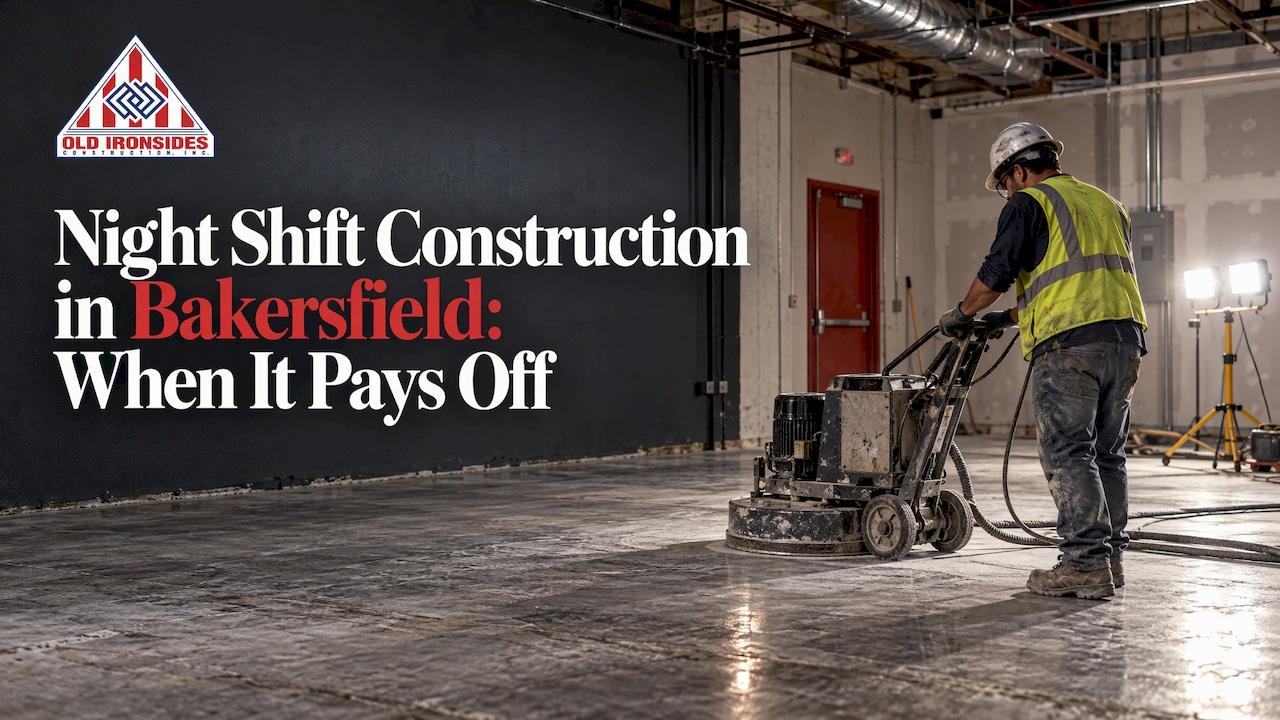
Night shift construction moves the noisy, disruptive or traffic-heavy part of a project to the hours when your building or roadway is quiet. It is worth the added cost when a day-time closure would cost you more than the premium: a school that cannot lose classrooms, an office that cannot lose a workday, a public street that cannot lose a lane at rush hour. In Bakersfield, a city noise ordinance limits when work can happen, so the decision has to be made with the permit rules, the lighting requirements and the budget in front of you. Our approach at Old Ironsides is design-build with self-performing crews and phased work in occupied facilities, which lets you decide early which scope truly needs to move to the night and which can stay on a day schedule.
This guide is written for owners, property managers, school districts and public agencies who hire a contractor. It is not a guide to finding night-shift jobs.
Table of Contents
- What night shift construction actually involves
- Is night work safer? Not automatically
- What it costs and what it does to your schedule
- Bakersfield rules you have to plan around
- Lighting and glare: the Cal/OSHA numbers
- Setting shift length and crew schedules
- Planning night work in an occupied building
- Why one accountable team makes night work easier
- Our perspective
- Talk to us about your schedule
- FAQ
- Sources
What night shift construction actually involves
Night work means crews operate after dark with temporary lighting, high-visibility clothing, a plan for managing fatigue and, on roads or driveways, traffic control. Nothing about the trade changes. What changes is everything around it: deliveries, inspections, staffing and the neighbors.
There are a handful of reasons owners choose it, according to a construction planning guide: daytime lane closures would cause unacceptable congestion, an occupied building such as a hospital, school, office or store has to be empty or lightly used, heat-sensitive work such as concrete benefits from cooler hours in a hot climate, or a late project needs schedule recovery. For highways, the Federal Highway Administration says high daytime traffic volumes make work in or near travel lanes difficult, which is why off-peak and night work is increasingly scheduled.
Kern County readers will recognize the pattern. Central Valley summers are hot, and a retail center or warehouse that cannot close during business hours needs another window.
Is night work safer? Not automatically
It is easy to assume that fewer cars and fewer people mean fewer risks. Illinois DOT cautions that night is not automatically safer: lighter traffic can mean faster vehicles, and drivers on the road at night are more often drowsy or impaired. Its decision ranking puts safety of the public and workers first, then job efficiency, manpower availability, productivity, cost and the effect on the surrounding area.
FHWA lists the same hazards for night work zones: reduced visibility, driver fatigue and impaired driving. Its answer is clear signage, effective lighting, high-visibility apparel and well-planned traffic control.
For an interior renovation the hazards shift. You have fewer people in the building, but those present may be working alone. A night plan needs a check-in routine, a clear emergency access path and a defined list of who is authorized on site. Our guide on controlling who enters a construction site covers the access side, and our safety page describes how we approach safety on our projects.
What it costs and what it does to your schedule
Plan for a premium. Illinois DOT says night work generally adds 10% to 25% to costs compared with daytime work. The added money goes to deliveries, equipment repairs, staffing, higher labor costs and specialized lighting. It can also slow the pace of work, though in rare cases moving part of the scope overnight while keeping a day schedule speeds the whole project up.
A worked example shows how to judge it. Say a tenant improvement carries $400,000 of work that would have to happen on the days your staff are in the building. If only $80,000 of that is the noisy or disruptive scope (demolition, core drilling, slab work), a 10% to 25% premium on that portion is $8,000 to $20,000. Compare that with a week of idle staff or lost sales. Pushing the entire $400,000 to nights would put the premium at $40,000 to $100,000. The first is a targeted decision, the second is a blanket one.

This is why the scope split matters more than the percentage. Owners get the best value when only the tasks that truly cannot happen during business hours move to the night shift.
Bakersfield rules you have to plan around
Bakersfield regulates construction hours in Municipal Code section 9.22.050. Construction, demolition, alteration, repair and grading are limited to 6 a.m. to 9 p.m. on weekdays and 8 a.m. to 9 p.m. on weekends.
The code gives you these routes for work outside those hours:
- A night-work permit. The city manager may grant a permit for 9 p.m. to 6 a.m. for up to three days, with an extension of up to three more days.
- Distance from homes. Work at least 1,000 feet from residences is exempt.
- Emergency work is exempt.
- City street crews directed by the city engineer to work at night to ease traffic congestion are exempt, and so are city contractors doing that street work.
Two things follow. First, a multi-week night schedule next to housing does not fit a three-plus-three-day permit, so the project has to be built around short, intense night windows or placed where the distance exemption applies. Second, you should confirm the current text with the city before committing, because the municipal code is amended through ordinances.
Inspections count too. Bakersfield's proposed 2025-26 master fee schedule lists overtime inspection requests outside the standard 7 a.m. to 4 p.m. Monday to Friday workday at actual cost. If your work needs an inspection before it can be closed up, that cost belongs in the night-work budget. Check the city's adopted schedule for the current figures.
Building standards still apply at any hour. Bakersfield adopted the 2025 California Building Code by Ordinance 5204.
Lighting and glare: the Cal/OSHA numbers
California sets lighting minimums for construction in Title 8, section 1523. Minimum illumination levels, in foot-candles (a unit of light on a surface), include:
| Area | Minimum foot-candles |
|---|---|
| Nighttime highway construction | 10 |
| Shops and plant areas | 10 |
| Outdoor active construction areas, concrete placement, excavation, accessways | 5 |
| General, low-activity construction areas | 3 |
| Offices and first-aid stations | 30 |
For highway work, the lighting must illuminate the task while limiting glare to crews and avoiding interference with oncoming drivers' vision. The regulation gives examples: screens, lamps mounted below the top of the barrier wall, or varied beam angles.
If your project touches state roads, Caltrans adds its own expectations in its construction manual. Night-closure times are set by the district traffic operations office from traffic counts. Contractors are told to avoid splitting traffic into two streams, keep the work area to the shortest practical distance and shield lights so they do not blind approaching drivers. Flagger stations must be lit during darkness, and Class 3 high-visibility garments are recommended for night operations.
Glare is also a concern inside occupied buildings and for neighbors. Temporary work lights aimed through windows or at adjacent properties draw complaints quickly, and glare control matters for the people who return to the space the next morning.

Setting shift length and crew schedules
Shift design is where night jobs succeed or slip. One practitioner guide recommends 10-hour night shifts, commonly 6 p.m. to 4 a.m. or 7 p.m. to 5 a.m., no more than five consecutive night shifts without a day off, and a short break every two hours. Treat these as planning starting points rather than regulation, and set the final schedule with your contractor.
Two things protect your schedule:
- A stable crew. Rotating different subcontractors through a night window means each new crew must be briefed on the building, the access rules and the morning turnover. Keeping the core trades under one team cuts that handoff. Tools for managing multiple crews show how much paperwork this coordination creates when many parties are involved.
- A hard morning turnover. Every night shift ends with the space safe, clean and usable. Agree on what "ready by 6 a.m." means before the first shift: floors clear, dust contained, utilities live, no open penetrations.
Planning night work in an occupied building
Most owners who read this are not closing a highway lane. They are renovating a school wing, a clinic, a bank branch or an office floor. The planning questions look like this:
- Scope split. List every task and mark it "day OK" or "after hours only." Demolition, anything that shuts down power or water, and loud or dusty work are usual candidates for after hours. Framing, finishes and layout work often are not.
- Phasing. Break the building into zones so the occupied areas stay protected. Our piece on office renovation downtime walks through keeping a team working while the space changes.
- Access and security. Decide who holds keys, how crews badge in and out, and who is on site if an alarm triggers. Alarm monitoring and cleaning crews need to know about the night schedule.
- Deliveries and storage. Night receiving has to have someone to sign for materials and a place to stage them. A freight and receiving checklist helps you confirm the dock, the inspection of goods and the handoff.
- Neighbors and tenants. Tell adjacent tenants and nearby residents the dates and hours in writing. Surprise noise is what turns a permit extension into a complaint.
- Inspections. Line up inspectors early and account for the overtime inspection fees described above.
Industrial owners face the same issues on a larger scale. Our plant modernization guide explains how upgrades can be sequenced around live production.
Why one accountable team makes night work easier
Night work multiplies handoffs. A designer drew the layout, an engineer sized the systems, a general contractor scheduled the trades, and each of those subcontractors has its own availability. When one of them cannot make the night window, the shift is lost and the premium you paid for night labor is wasted.
A design-build team puts design, engineering and construction under one roof, so the question "does this need to be done at night?" is answered while the drawings are still being made. Old Ironsides self-performs core work with its own crews, which removes the subcontractor delays that tend to break tight schedules and leads to fewer changes and cost overruns. For tenant improvements, commercial remodels and public works, we phase work so your operations keep running.
Our perspective
Owners often ask us whether they should simply move everything to nights. Usually the better question is which few tasks truly cannot happen while people are in the building.
We treat the schedule as a design problem. When design, engineering and construction sit with one accountable team, we can sort the scope early, phase the building into zones and keep the disruptive pieces as short as possible. That is how occupied schools and public facilities stay open while the work goes on.
Self-performing our core work matters most when the window is short. If the crew that shows up is our own, a night shift does not depend on someone else's calendar.
The result is a night-work plan that costs less than a blanket overnight schedule, because the premium applies only where it earns its keep.
Marcelo
Talk to us about your schedule
If you are weighing night work for a renovation, tenant improvement or public works project in Bakersfield or the Central Valley, we can help you work out the scope split, the phasing and the schedule before you commit to a premium. See our commercial construction services or our design-build page to start a conversation.

For budget context on your project, our guide to commercial construction cost per square foot in Bakersfield is a good companion.
FAQ
Is night construction cheaper or more expensive?
More expensive per hour of work. Illinois DOT puts the typical increase at 10% to 25% over daytime work. The overall project can still cost less if night work prevents lost business or school days, so compare the premium with what a daytime disruption would cost you.
Can a contractor work at night in Bakersfield?
Yes, under conditions. The city code allows night work with a permit for up to three days, extendable by up to three more, and exempts emergency work and work at least 1,000 feet from residences. Confirm the current terms on the city's code page before you set dates.
How bright does a night work site have to be in California?
Cal/OSHA requires at least 10 foot-candles for nighttime highway construction and 5 for active outdoor construction areas. Offices and first-aid stations need 30. The full table is in Title 8, section 1523.
How long should a night shift be?
One planning guide recommends 10-hour shifts with no more than five in a row before a day off. Your contractor should set the final schedule around the site, the permit and the crew.
Sources
- Night Work in Construction: Safety and Planning
- Night Work/Off Peak Work, FHWA Work Zone
- Nighttime the right time for construction? Illinois DOT
- Bakersfield Municipal Code 9.22.050, Noise during construction
- City of Bakersfield Proposed Master Fee Schedule for 2025-26
- Bakersfield Municipal Code 15.05.010, Adoption
- California Code of Regulations, Title 8, Section 1523
- Caltrans Construction Manual, Chapter 2, Section 2: Traffic